
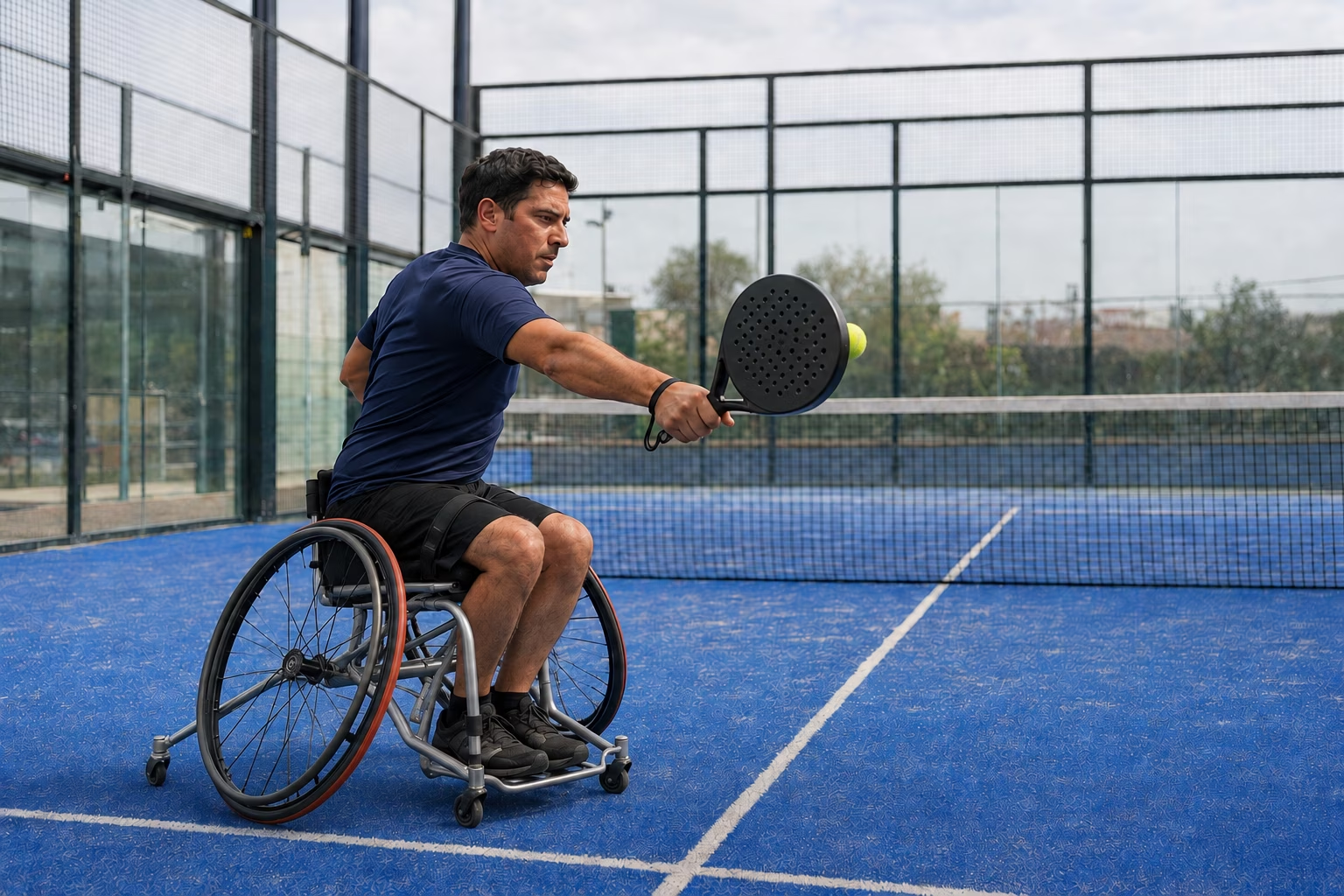
Wheelchair padel is one of the fastest developing forms of accessible padel, adapting the standard game so wheelchair users can play socially, train seriously and compete.
The basic ingredients remain familiar: the same enclosed court, rackets, walls, doubles format and scoring system.
The biggest difference is simple but important, wheelchair players are generally allowed two bounces of the ball instead of one. This change gives players more time to move into position while preserving the rallies, angles and tactical use of the glass that make the sport so distinctive.
Interest in accessible padel in the UK is beginning to grow alongside the wider Padel boom, with disability sessions, inclusive competitions and players such as Great Britain No.1 Louis Telford helping make adaptive Padel more visible.
Quick answer
What is wheelchair padel?
Wheelchair Padel is an adapted form of Padel played by wheelchair users on a standard Padel court. The main adaptation is that the ball can bounce twice before being returned. Most of the standard rules, scoring and use of the glass walls remain the same. Accessible court entrances and enough room for a sports wheelchair are also important. In Britain, disability and adaptive Padel opportunities are supported through programmes including the LTA Open Court initiative.
How Is wheelchair padel Different?
Wheelchair padel takes the core game of padel and adapts it for players using sports wheelchairs.
It is normally played as doubles on the same 20m x 10m enclosed court used for conventional padel.
Players still serve underarm, play the ball over a net and use the surrounding glass walls as part of rallies.
The objective is exactly the same: make it difficult for the opposing pair to return the ball legally.
What changes is the amount of time wheelchair players have to reach the ball and some of the practical requirements around serving, movement and court access.
The result is not a slower exhibition version of padel.
Competitive wheelchair padel can be quick, tactical and demanding, with positioning, anticipation and chair control becoming major parts of the game.
What are the rules of wheelchair padel?
The most important rule to understand is the two-bounce rule.
In conventional padel, the ball must normally be returned before it bounces for a second time.
In wheelchair padel, players are allowed two bounces before returning the ball.
That means the shot must be played before a third bounce.
The extra bounce allows additional time for wheelchair movement without removing the tactical character of the game.
The glass still matters. Players can allow the ball to bounce and rebound from the glass before returning it, just as they can in the conventional game.
Wheelchair padel rules at a glance
Standard padel: one bounce allowed
Wheelchair padel: two bounces allowed
Court: standard enclosed padel court
Format: generally doubles
Scoring: follows conventional padel scoring unless a particular competition specifies otherwise
Walls: remain in play
Equipment: Racket, balls and suitable sports wheelchair
Individual tournaments and governing bodies can operate specific adapted competition rules, so competitive players should always check the regulations for the event they are entering.
Is wheelchair padel played on a normal padel court?
Yes, one of the major advantages is that it does not require an entirely separate playing surface.
A standard court can be used, provided the player can safely access and move around the court.
This is important because a venue may advertise itself as accessible as they have step free access to the building while still having a court entrance that is difficult or impossible to negotiate in a sports wheelchair.
The LTA’s padel court construction guidance specifically addresses this.
For sports wheelchair access, there should be at least 1.2 metres of clearance between the net post and the court enclosure.
Gates, entrances and the route from the car park to the court also need to be considered.
So when asking whether a club is wheelchair accessible, the answer should involve more than simply asking whether the venue has disabled parking.
What makes a padel court genuinely wheelchair accessible?
Good accessibility starts before the player reaches the court.
Ideally, a venue should consider the entire journey.
That includes:
- accessible parking or drop-off
- a level route into the venue
- suitable door widths
- accessible changing and toilet facilities
- enough space to move a sports wheelchair around reception and social areas
- step-free access to the courts
- sufficiently wide court entrances
- suitable space between the net post and enclosure
- a court surface that can be safely negotiated in a sports wheelchair
For new UK Padel developments, accessibility should be considered during the design stage rather than treated as an alteration to make later.
PadelTalk’s court directory is being developed to make finding and comparing venues easier.
As our directory expands, wheelchair accessibility and adaptive Padel provision are areas we want to identify much more clearly so look out for improvements from us on this front in the future.
What is adaptive padel?
Adaptive padel is a broader term than wheelchair padel.
It describes padel that has been modified or delivered in a way that allows people with different disabilities or additional needs to participate.
That can include:
- wheelchair users
- amputee players
- players with physical impairments who play standing
- players with learning disabilities
- players with sensory impairments
- people living with long-term health conditions
- mixed-ability groups
The exact adaptations depend on the players. For some, the standard rules may need very little alteration. For others, coaches might adjust the number of bounces, court area, pace of feeds, scoring format or equipment.
The purpose is not necessarily to make every session identical, it’s to create a form of the game that allows meaningful participation.
What is the difference between wheelchair padel and adaptive padel?
The terms overlap, but they do not mean exactly the same thing.
Wheelchair padel specifically refers to padel played using a wheelchair.
Adaptive padel is the wider category covering padel modified for players with different disabilities or additional requirements.
You may also see terms such as:
accessible padel
inclusive padel
disability padel
para padel
Different organisations use slightly different terminology.
In Britain, the LTA commonly refers to disability and adaptive padel, while inclusive events may bring disabled and non-disabled players onto court together.
Can disabled and non-disabled players play padel together?
Yes, Padel lends itself particularly well to mixed-ability social play because rules can be adjusted without fundamentally changing the game.
An inclusive match could involve disabled and non-disabled players playing together, with adaptations applied to the player who needs them.
There are also organised formats built specifically around this idea. The Inclusive Padel Tour, for example, has staged events involving teams made up of disabled and non-disabled players.
A UK edition at Padel Maidenhead in 2026 attracted 32 pairs from several European countries. This was different from a dedicated adaptive competition, where players may compete within particular disability categories, but both approaches have value.
One creates genuinely mixed participation.
The other provides a competitive pathway for adaptive athletes.
Is there competitive wheelchair padel?
Yes.
Wheelchair and adaptive padel are developing competitive structures internationally as participation grows.
The Adaptive Padel Tour includes competition for wheelchair and standing adaptive players, while inclusive competitions bring disabled and non-disabled players together.
Britain also has a growing group of competitive adaptive players.
One of the most prominent is Louis Telford, who is currently Great Britain’s No.1 wheelchair padel player.
The Wigan athlete previously competed in wheelchair basketball before progressing rapidly through wheelchair padel.
Read how GB No.1 Louis Telford joined Soul Padel
Players such as Telford are important because visibility matters.
The more disabled athletes people see playing competitive padel, the easier it becomes for somebody considering the sport for the first time to imagine themselves on court.
Is wheelchair padel growing in the UK?
It is still a small part of British padel, but there are clear signs of development.
The LTA now explicitly includes disability padel within its participation work.
Its Open Court programme supports venues delivering opportunities for disabled players, including wheelchair users, people with learning disabilities and people living with conditions such as Parkinson’s or dementia.
Adaptive padel has also appeared at major UK community events.
In 2026, GB adaptive player Andrew Simister and wheelchair No.1 Louis Telford delivered adaptive sessions during the Pro Am Padel Tour event in Manchester.
The Inclusive Padel Tour has also held UK competition at Padel Maidenhead.
These are still relatively early steps, but they show that accessible padel is developing alongside the mainstream sport rather than completely separately from it.
Where can I play wheelchair padel in the UK?
There is not yet a single comprehensive UK directory dedicated solely to wheelchair padel.
For now, there are several ways to find opportunities.
The LTA’s Open Court programme works with venues across Great Britain to provide disability and adaptive tennis and padel sessions.
Individual clubs are also beginning to offer their own accessible programmes.
For example, Rocks Lane Chiswick has supported adaptive padel and says it has sports wheelchairs available for people wanting to try the game.
Players should contact a venue before travelling and ask specifically about:
- wheelchair access onto the court
- accessible toilets and changing facilities
- sports wheelchair availability
- adaptive coaching
- disability or inclusive sessions
- accessible parking
- competitive opportunities
Simply asking whether the building is “accessible” may not tell you whether the padel courts themselves are suitable.
You can also use the PadelTalk court finder to find clubs in your area and contact them about wheelchair and adaptive padel provision.
Do I need a sports wheelchair to play padel?
For regular or competitive wheelchair padel, a sports wheelchair is strongly preferable.
Sports wheelchairs are designed to make turning, accelerating and changing direction much easier than everyday chairs.
This is important because points involve repeated changes of direction and movement forwards, backwards and across the court.
However, somebody trying adaptive padel for the first time may not necessarily need to buy a chair immediately.
Some inclusive programmes and specialist venues have sports wheelchairs available for beginners to use.
It is worth asking the organiser before booking.
For example, Rocks Lane Chiswick states that it has sports wheelchairs available for people wishing to try adaptive padel.
Is padel suitable for people with limited mobility?
Potentially, yes.
Wheelchair padel is only one example of how the sport can be adapted.
The smaller court, doubles format and relatively short distances involved can make the sport suitable for players who would find larger-court racket sports more difficult.
But accessibility varies significantly between individuals.
Some players may need altered rules or coaching.
Others may need a wheelchair or mobility equipment.
For some conditions, medical advice may also be appropriate before starting a new form of physical activity.
The useful question is therefore not simply:
“Can somebody with a disability play padel?”
It is:
“What adaptation would allow this particular person to play padel safely and enjoyably?”
That is the principle behind accessible padel.
Is padel suitable for people with learning disabilities?
Yes, and padel programmes can be adapted in several ways.
Sessions might use:
- simpler instructions
- slower feeding
- shorter activities
- visual demonstrations
- smaller playing areas
- modified scoring
- additional coaching support
The LTA specifically includes players with learning disabilities within its disability padel work.
For many players, the social element of padel can be as important as the competitive one.
Four people sharing a relatively small court creates constant interaction, making padel naturally suited to group activity.
Can people with Parkinson’s or dementia play padel?
The LTA’s disability padel programme specifically includes opportunities for people living with long-term health conditions including Parkinson’s and dementia.
That does not mean every form of the sport is appropriate for every individual. Sessions may need to be adapted for movement, balance, fatigue or cognitive requirements.
Specialist or supported sessions are likely to be more appropriate than simply entering a fast paced social match.
We’d encourage players or carers to speak to the venue and, where appropriate, a healthcare professional about individual circumstances.
Why could padel become a major inclusive sport?
Padel has several characteristics working in its favour.
- The court is smaller than a tennis court.
- Most padel is played as doubles.
- The serve is underarm.
- The walls keep many balls in play.
- Beginners can normally sustain rallies relatively quickly.
- And the sport already has a culture built heavily around social participation.
None of those things automatically make a venue accessible, but they give clubs and governing bodies a strong foundation to build on.
The biggest risk would be allowing thousands of new courts to be constructed without considering disabled players until afterwards. That is why details such as wheelchair-friendly court entrances matter now.
Britain is still building much of its Padel infrastructure and there is an opportunity to make accessibility part of that growth from the beginning.
What should padel clubs do to become more accessible?
The first step is to think beyond compliance. Being able to enter the building is not the same as being able to participate fully. Clubs should consider the complete player journey and ask the following questions:
- Can the player park nearby?
- Can they enter independently?
- Can they reach reception and changing facilities?
- Can a sports wheelchair fit comfortably through the court entrance?
- Are coaches confident adapting sessions?
- Can disabled players join regular social activity rather than only occasional disability events?
- Are accessible sessions clearly advertised?
Those questions turn accessibility from a box-ticking exercise into meaningful participation.
Clubs that already offer wheelchair or adaptive padel can also tell PadelTalk about their provision so we can improve the information available through our venue directory.
How can I start playing wheelchair or adaptive padel?
If you want to try the sport, the process can be fairly simple.
Find nearby padel venues and ask whether they offer wheelchair padel, disability padel or adaptive sessions.
If they do not, ask whether they can accommodate an adapted coaching session.
You can also look for LTA Open Court venues and inclusive padel events.
Before booking, confirm that you can physically access the court and ask whether a sports wheelchair is available if you need one.
Your first session does not need to be competitive and should really just be about trying the sport and seeing if you enjoy it.
Like conventional padel, the easiest way to understand wheelchair padel is normally to get onto court and start hitting balls!
Wheelchair Padel FAQ
How many bounces are allowed in wheelchair padel?
Wheelchair padel normally allows the ball to bounce twice before it must be returned. This is the most important adaptation from standard padel.
Do wheelchair padel players use the same court?
Yes. Wheelchair padel is played on a standard padel court, although the entrance and surrounding venue need to provide sufficient wheelchair access.
Is wheelchair padel played as doubles?
Wheelchair padel is primarily played as doubles, like conventional padel.
Can wheelchair users play with non-disabled padel players?
Yes. Inclusive padel can involve disabled and non-disabled players competing together, with adaptations such as an additional bounce used where appropriate.
Are there wheelchair padel competitions in the UK?
Competitive adaptive and inclusive padel is developing in Britain. UK players participate in events including inclusive and adaptive competitions, while the LTA is expanding disability padel opportunities through its Open Court programme.
Where can I find accessible padel courts?
Start with the PadelTalk UK padel court directory and contact venues directly to confirm court access and adaptive provision. The LTA Open Court programme is another useful route to finding disability padel opportunities.
PadelTalk’s Accessible Padel Hub
PadelTalk wants to help make wheelchair padel and accessible padel easier to find in the UK.
As this section develops, we plan to bring together:
- wheelchair-friendly padel venues
- adaptive padel sessions
- accessible coaching programmes
- wheelchair and adaptive players
- competitions and events
- news from the disability padel community
- guides for players and clubs
If you operate a UK padel venue offering wheelchair or adaptive padel, we want to hear about it.
Likewise, if you play adaptive padel and think a venue, coach, competition or initiative should be featured, let us know.
The growth of British padel should not only be measured by how many courts are built.
It should also be measured by how many people are able to use them.